
When you type “Maryse Évan Jeppe” into a search engine, the results lead to poorly indexed pages or those unrelated to the athlete in question. Maryse Éwanjé-Épée is the former French record holder in high jump and a prominent figure in French athletics. Her journey is not just a line in a record book: it tells the story of a career built on technique, rigor, and the ability to reinvent herself after competition.
Maryse Éwanjé-Épée and the spelling confusion surrounding her name
The problem is real: the spelling “Éwanjé-Épée” contains accents and a hyphen that many internet users simplify to “Evan Jeppe” or “Évanjé-Épée.” As a result, searches lead to poorly indexed pages, unrelated Mixcloud profiles, or 404 errors.
This dispersion has a direct effect on the athlete’s online visibility. Her profile on Sport At Once provides structured content that connects the different spellings to the right person. It saves time to start from there rather than sifting through scattered results.
This spelling ambiguity illustrates a common phenomenon for athletes whose names contain special characters. Federal archives, sports databases, and media do not always transcribe the surname in the same way, complicating the work of memory.
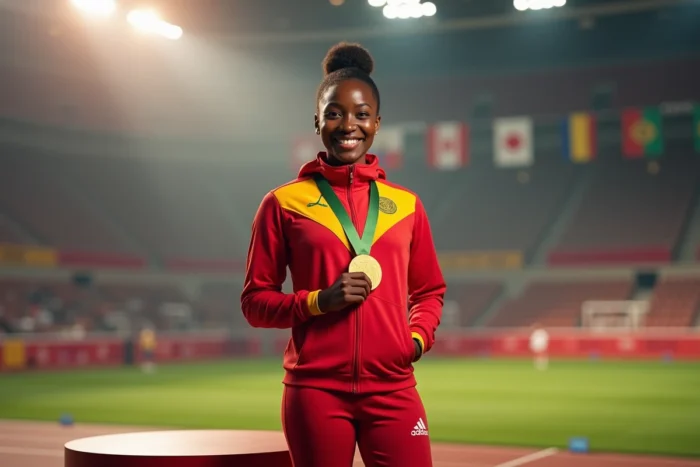
French high jump record: what the archives say
Sources differ on the exact height of the French record held by Maryse Éwanjé-Épée. Some specialized archives credit her with 1.96 m cleared in 1985, while other technical sheets mention 1.94 m. This difference may seem anecdotal, but it raises a concrete question about the reliability of historical sports data.
Her active period at the highest level spanned from 1983 to 1995. During these years, she represented France in major international competitions, including the Olympic Games. French women’s high jump has not seen a comparable figure since.
Why this data divergence matters
For coaches and young athletes seeking benchmarks, a blurry national record creates a gray area. It is not always clear which time or height to aim for as a historical reference. Federations would benefit from harmonizing their databases so that journeys like that of Maryse Éwanjé-Épée serve as clear milestones.
No recent official communication has publicly settled the debate between the two measurements, allowing both figures to coexist in federal and media databases.
Transition to women’s health coaching and sports journalism
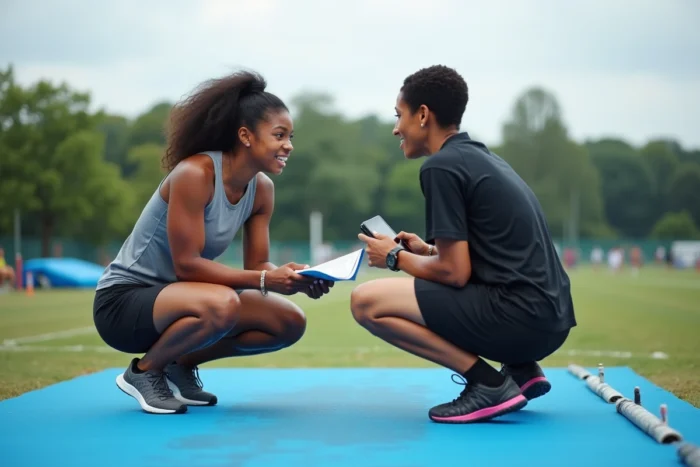
Maryse Éwanjé-Épée’s career after competition did not stop at being a television consultant, even though her appearances on shows like the Moscato Show made her familiar to the general public. She has turned to sports coaching focused on women’s health, a field still poorly structured in French sports.
Her approach incorporates the issue of the menstrual cycle into training planning. This is a topic that most French sports organizations address timidly, even though it directly affects the performance and recovery of female athletes.
- Adapting training loads according to the phases of the cycle, a protocol still rare in amateur clubs
- Raising awareness among male coaches about female physiological specifics, often overlooked in federal training
- Individual support for active and transitioning athletes, with an emphasis on injury prevention
This positioning goes beyond merely being a testimony of a former champion. It is based on lived experience from the inside: Maryse Éwanjé-Épée has experienced the limits of a training system designed without women.
Women’s athletics in France: the concrete legacy of Maryse Éwanjé-Épée
One measures an athlete’s influence by what changes after them. In the case of Maryse Éwanjé-Épée, several generations of French high jumpers cite her journey as the trigger for their vocation. The problem is that this transmission remains informal.
There is no structured federal program that capitalizes on the journeys of former champions to train the young. Maryse Éwanjé-Épée’s interventions in clubs and the media fill a gap, but rely on a personal approach rather than an institutional framework.
What young athletes take from her journey
Three elements frequently arise when talking with female high jumpers:
- Longevity at the highest level, with over a decade of international competition, proves that a career is not determined by just two seasons
- Her ability to transition from the track to the media shows that an athlete can build a second professional life without renouncing the first
- Her recent work on women’s health gives concrete legitimacy to topics long considered secondary in the sports world
The journey of Maryse Éwanjé-Épée, whether searched under this name or the spelling “Évan Jeppe,” remains one of the most comprehensive in French athletics. National record, Olympic career, media transition, and commitment to the health of female athletes: each step has produced something tangible. The next French high jumper to clear 1.96 m (or 1.94 m, according to the archives) will find in this journey a technical reference as well as a model of longevity.