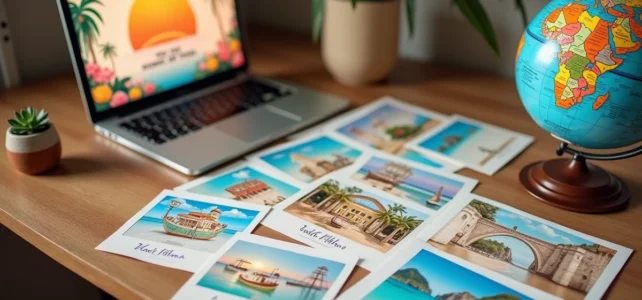
A virtual holiday card is a digital visual, often accompanied by personalized text, sent via messaging or email to share a travel moment with loved ones. The accompanying text makes all the difference between a quickly forgotten gesture and a message that the recipient will read again. Here are ten concrete formulations, each tailored to a specific situation, for writing inspiring holiday cards without falling into generic phrases.
Several platforms offer free holiday card templates on Voyager en Découverte that make layout easier even before writing the message.
1. The geolocated message that tells about a specific place

Naming the exact location and associating it with a feeling transforms a simple hello into a miniature travel story. The formula works because it anchors the message in reality.
Example: “This morning, the spice market in [city] smelled of roasted cumin and fresh mint. I thought of you in front of a stall of blue ceramics, exactly your style.” This type of text gives the recipient the impression of sharing the discovery, not just receiving news.
2. The author’s quote integrated into a personal anecdote

Workshops on cultural mediation through digital postcards encourage mixing a writer’s phrase with a travel experience. The quote serves as a starting point, and the anecdote makes it unique.
Example: “’The real voyage consists not in seeking new landscapes, but in having new eyes.’ Proust was right, I just spent twenty minutes watching a lizard on a whitewashed wall and it was perfect.”
3. The sensory text in three short sentences
Three sentences, three different senses. This structure imposes conciseness and produces a quick immersion effect.
Example: “The water is so clear that you can see the pebbles three meters down. The air smells of pine resin warmed by the sun. And the village bread crunches under the teeth like nowhere else.” Three senses are enough to recreate an entire place.
4. The word for an isolated senior
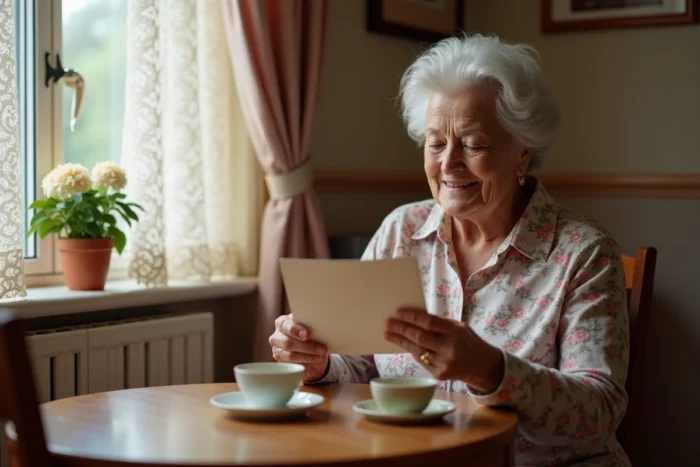
Several communities encourage sending digital postcards to isolated elderly people during the summer. The text should be simple, readable, and warm, without being patronizing.
Example: “Dear Mrs. Duval, the hydrangeas are in bloom here, as blue as those in your garden. I’m sending you a bit of Breton sunshine and lots of thoughts.” Mentioning a detail known to the recipient shows that the message is genuinely addressed to them.
5. The humorous message at an inopportune moment

Humor works best when it plays on the contrast between the idyllic setting and a mundane detail. The recipient smiles because the text breaks the cliché of the perfect postcard.
Example: “Paradise beach, turquoise water, palm trees. And me, a sunburn in the shape of sunglasses and sand in every possible nook. I miss you anyway.”
6. The local recommendation as a gift
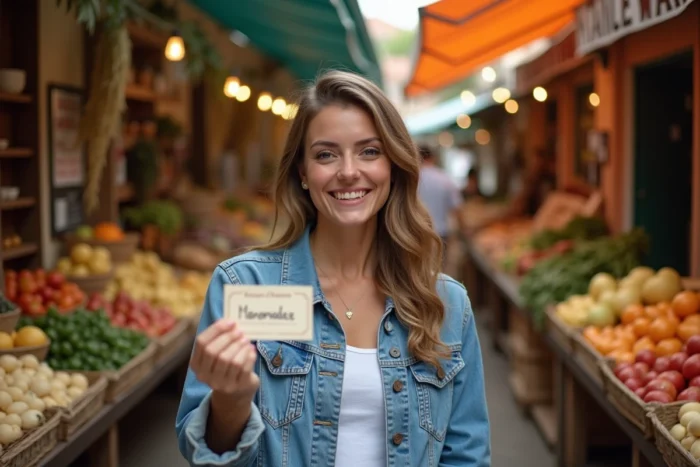
Transforming the card into a mini personal travel guide offers concrete added value. If the recipient visits the area one day, they will have a tested address.
Example: “If you ever pass through [city], head straight to the bakery [name], on [X] street. Their olive fougasse is worth the detour, and the owner tells the story of the wood oven to anyone who wants to hear it.”
7. The bilingual text for a recipient abroad

When the recipient lives in another country, slipping in a phrase in their language and then continuing in French creates immediate rapport. The gesture shows effort, not just an automatic translation.
Example: “Buongiorno dalla Sardegna! The water is exactly the color you described. Now we understand why you didn’t want to leave. Big hugs from the beach.”
8. The collective solidarity card signed by a group

A card signed by multiple people has more impact than an individual message, especially for someone who couldn’t go away. Each signer adds a line in a different style, giving the text a lively texture.
Example structure:
- Line 1 (organizer): “We’re thinking of you from [place], here’s a word from each of us.”
- Line 2 (friend A): “Yesterday’s hike would have pleased you; there were marmots everywhere.”
- Line 3 (friend B): “I tasted the local cheese. You would have hated it. I love it.”
- Line 4 (friend C): “Come back soon; we’re saving you a spot in the sun.”
9. The message of an intentional digital detox

The paradox of sending a digital card to announce that one is disconnecting from the digital world creates an effective stylistic effect. The text should remain brief, almost a notice of temporary disappearance.
Example: “This is my last message before a week without screens. The phone is going into airplane mode, and my feet are going into the sand. I’ll come back tanned and unreachable. See you soon.” Notifying of one’s absence is also a form of attention.
10. The cultural card with a historical anecdote of the place
Some cultural mediation workshops use the digital postcard as a medium to convey knowledge in a short format. The text associates a local historical fact with a direct observation.
Example: “This perched village was a refuge for shepherds in the Middle Ages. Today the narrow streets are full of cats and wisteria, but the dry stone walls still stand. Next time, we’ll climb up together.”
- Adapt the historical fact to the recipient’s level of knowledge to maintain interest
- Always associate the fact with a visual detail observed on site
- End with an invitation or a shared projection to create a bond
The text of a virtual holiday card gains impact when it addresses a specific person, in a specific context, with a detail that no one else could have written. Generic phrases fill the space, a shared memory fills the mind.