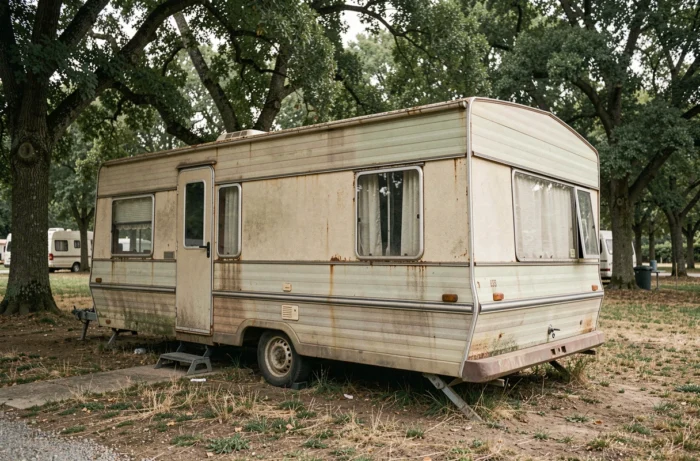
The twenty-year threshold crystallizes tensions between campsite managers and mobile home owners, but it does not correspond to any standalone legislative text. The legal framework relies on a combination of provisions from the Urban Planning Code, technical standards, and private contractual clauses. Understanding their interplay avoids costly mistakes during contract renewal or resale.
Reclassification as construction: the real legal risk of an old mobile home
A mobile home remains a mobile leisure residence as long as it retains its means of mobility. Articles R111-41 to R111-46 of the Urban Planning Code condition this status on the maintenance of wheels and the towing device. As soon as these elements are removed, or when permanent foundations replace the original supports, the property can be reclassified as a construction.
This reclassification changes everything: a building permit becomes required, local PLU applies, and property tax becomes applicable. On land classified as natural or agricultural zone, it can even lead to a demolition obligation.
We observe that this risk increases with the age of the mobile home. After two decades, owners often add fixed terraces, masonry awnings, or permanent connections to utilities. Each modification that reduces effective mobility weakens the legal status. A municipal urban planning inspection can then trigger a procedure, regardless of the technical condition of the mobile home itself.
To delve deeper into what the law provides for mobile homes over 20 years old, it is essential to clearly distinguish between what falls under urban planning law and what falls under the private contract with the manager.

Obsolescence clauses in the plot contract: validity conditions
The rental contract for the plot is the main lever available to campsite managers and residential leisure park operators. No law mandates the replacement of a mobile home at a certain age, but the contract can set an age limit if certain conditions are met.
An obsolescence clause is not abusive by nature. It becomes so when it imposes a replacement without objective technical justification. To withstand a challenge, the clause must rely on verifiable criteria:
- The structural condition of the chassis and roof, assessed according to the NF S 56-410 standard applicable to mobile leisure residences
- The compliance of electrical and gas installations with current standards, supported by a recent technical inspection
- The effective maintenance of means of mobility, certified by a contradictory report
- The absence of modifications that have altered the original characteristics of the vehicle (structural additions, elevation, non-removable extension)
A manager who demands the departure of a mobile home in good condition solely based on its year of manufacture risks having the clause reclassified as abusive by the judicial court. We recommend keeping all maintenance and technical inspection documents to support any potential appeal.
Administrative status of the land: a prior check before any purchase
Not all lands hosting mobile homes benefit from the same legal regime. A classified campsite, a residential leisure park operated under hotel regulations, and a PRL under plot transfer regime are subject to distinct rules regarding duration of occupation and owner rights.
The date of creation of the land also matters. Some parks predating the reforms of the Urban Planning Code operate under a derogatory regime that may limit the rights of occupants. Before purchasing a second-hand mobile home on a plot, checking the administrative classification of the land with the town hall is a non-negotiable step.
Checkpoints before signing
The plot rental contract must explicitly mention the duration, renewal conditions, and reasons for non-renewal. A contract that does not specify these elements leaves the owner in total legal insecurity.
The departmental conciliation commission, competent in rental disputes, can be called upon in case of disagreement over renewal. This amicable route remains underutilized, even though it often helps to resolve situations without procedural costs.
Taxation and insurance of an aging mobile home
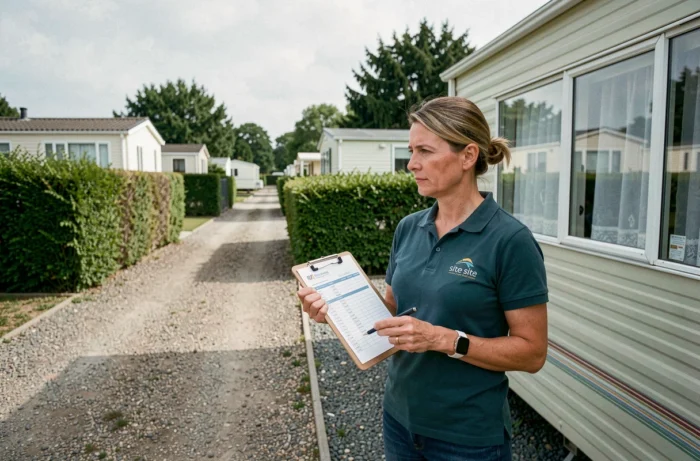
As long as the mobile home retains its status as a mobile leisure residence, it is not subject to property tax or housing tax on secondary residences. The loss of mobile status triggers liability for local taxes, with potential back taxes for several years.
Insurance poses a different problem. After a certain age, several insurers refuse to cover a mobile home or apply discouraging deductibles. The market value drops, but the replacement cost in case of damage remains high. Checking coverage conditions before renewing a plot contract avoids ending up with an uninsurable property on a paid plot.
Assistance and programs for concerned owners
There is no national aid program specifically for owners of old mobile homes. Some local authorities offer occasional support for bringing leisure accommodations up to standard, but these aids vary significantly from one territory to another.
The right to resell remains intact regardless of the age of the mobile home, provided that the plot contract does not contain a preemption or approval clause in favor of the manager. Checking for the existence of such a clause before any sale helps avoid a blockage at the time of the transaction.
The longevity of a mobile home depends more on its structural maintenance and the solidity of its plot contract than on an arbitrary age threshold. Regular technical diagnostics, a plot contract reviewed by a legal professional, and monitoring the administrative status of the land remain the three pillars of peaceful occupation beyond twenty years.