
The management of chronic pain involves a variety of skills, distributed among several categories of professionals. Doctors, physiotherapists, psychologists, adapted physical activity instructors: each intervenes at a specific moment in the journey, with different reimbursement modalities and levels of evidence. Understanding who does what, and especially what each intervention concretely brings, allows for a coherent support system rather than multiplying consultations without a guiding thread.
Reimbursement and real access to pain care: what the law provides and what is lacking
The French legislative framework has evolved regarding adapted physical activity (APA). The 2016 law opened the possibility of prescribing APA through a medical prescription, and a 2022 expansion extended this prescription to individuals with chronic illnesses, presenting certain risk factors or in a situation of loss of autonomy.
The problem arises after the prescription. An APA prescription does not guarantee reimbursement by the Health Insurance. Funding depends on local authorities, territorial schemes, or the patient’s supplementary health insurance. This reality creates notable geographical disparities.
Consultations in a specialized pain assessment and treatment center (CETD) are still covered within the hospital framework. However, access to these structures requires a referral from the treating physician, and waiting times vary significantly from one region to another. Cross-referencing the professionals on Mon Coach Douleur with available local resources helps to quickly identify the appropriate practitioners for one’s situation.
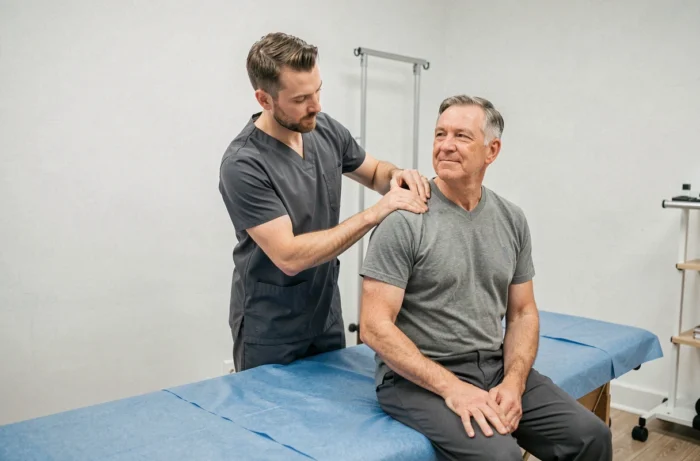
Graduated pathway for chronic pain: who intervenes and at what level
The High Authority of Health recommends a graduated and biopsychosocial approach, meaning an approach that is not limited to medication. The table below summarizes the main professionals involved, their role in the pain pathway, and the framework for care.
| Professional | Role in the pain pathway | Financial coverage |
|---|---|---|
| General practitioner | Initial assessment, prescription, referral to a specialist or CETD | Standard Health Insurance reimbursement |
| Pain specialist (CETD) | Expertise, multidisciplinary consultation, technical procedures (neurostimulation) | Hospital framework, standard coverage |
| Physiotherapist | Functional rehabilitation, targeted exercises, progressive mobilization | On prescription, partial or total reimbursement |
| Psychologist / CBT therapist | Cognitive-behavioral therapies, stress management, therapeutic education | Variable (MonPsy scheme or hospital consultation) |
| APA instructor | Adapted physical activity, reconditioning, maintaining autonomy | Not generally reimbursed, local or supplementary funding |
This table highlights a gap between the diversity of recommended practitioners and the heterogeneity of their financial coverage. The psychologist and the APA instructor remain the least well-covered links, even though their contribution is included in official recommendations.
Adapted physical activity and chronic pain: an underfunded lever
APA is not traditional sport. It is based on programs designed for individuals whose physical condition, pathology, or pain level requires specific supervision. Sessions can be led by qualified APA instructors or trained physiotherapists.
The HAS positions physical activity as a pillar of chronic pain treatment, alongside rehabilitation or cognitive-behavioral therapies. For chronic low back pain, for example, recommendations emphasize the gradual resumption of activity rather than rest.
The main barrier remains financial. Patients who do not benefit from a local scheme or a mutual insurance covering these sessions must fully finance them. This leads to dropouts in the care pathway, even though APA has been legally integrated into the care pathway since 2022.
Criteria for choosing an APA professional
- Check the diploma: STAPS license with APA mention or equivalent recognized. A sports coach not trained in chronic pathology does not meet the same requirements
- Ensure that the professional works in connection with the prescribing physician, to adapt the program to the evolution of pain
- Prefer structures that offer an initial assessment of physical condition and regular monitoring of progress

Therapeutic education and cognitive-behavioral therapies: two complementary approaches
Patient therapeutic education (ETP) aims to empower patients to understand their pain, identify aggravating factors, and actively participate in their care. It is often provided in CETDs or in certain multi-professional health centers.
Understanding the mechanisms of pain reduces anxiety and changes the perception of pain intensity. This finding, derived from the literature on chronic pain, justifies the systematic integration of ETP into the pathways recommended by the HAS.
Cognitive-behavioral therapies (CBT) complement this approach by working on thought patterns associated with pain. The goal is not to deny pain but to modify the emotional and behavioral response it provokes. Relaxation, cognitive restructuring, and gradual exposure are among the techniques used.
- ETP conveys knowledge: mechanisms of pain, crisis management, adaptation of daily activities
- CBT modifies reactions: catastrophizing, avoidance, hypervigilance towards bodily sensations
- Both approaches work better in combination than in isolation, and their effectiveness depends on the regularity of follow-up
Building a coherent pain pathway: criteria for choice
The risk, given the multiplicity of practitioners, is to consult without coordination. A physiotherapist working on mobility, a psychologist treating anxiety, and an APA instructor proposing reconditioning can complement each other, or contradict each other if no one centralizes the information.
The general practitioner or pain specialist remains the pivot of the pathway. It is at this level that assessments are synthesized, orientations are adjusted, and any interventional techniques (neurostimulation, injections) are decided.
Before adding a new professional to one’s pathway, three questions deserve to be asked: does this intervention meet a need identified during an assessment? Does the professional communicate with the rest of the team? Is funding anticipated, especially for non-reimbursed procedures?
The management of chronic pain becomes more effective when it relies on a limited number of well-coordinated practitioners, rather than on an accumulation of isolated consultations. The challenge remains to align official recommendations with funding realities, which still leave too many patients without access to care that is recognized as useful.