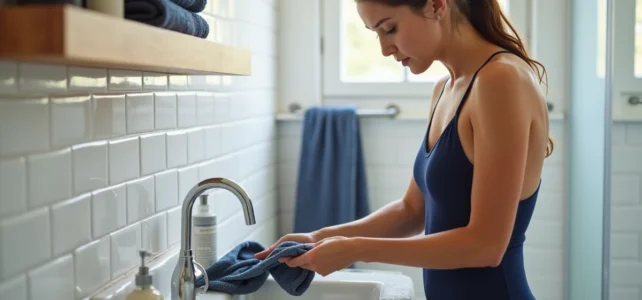
A polyamide/elastane swimsuit that compresses at the thighs or chest is not usually a result of a poor size choice. The issue arises from the mechanical behavior of elastic fibers subjected to thermal or chemical stresses. Knowing how to relax a swimsuit that is too tight requires understanding why elastane retracts, and especially which manipulations to avoid to prevent accelerating its degradation.
Elastane and thermal retraction: what happens in the fiber
Elastane (or Spandex) is a segmented polyurethane polymer. Its soft segments give it the ability to stretch, while its rigid segments ensure elastic recovery. When the fiber is exposed to a temperature higher than that of its normal use, the rigid segments reorganize and the swimsuit loses part of its residual stretch.
Specifically, a tumble dry, washing at over 30 °C, or drying on a radiator causes permanent contraction. Recent guides from major brands confirm this recommendation: no direct heat source to preserve elastane, even when the swimsuit seems too tight.
Pool chlorine also attacks the chemical bonds of polyurethane. After a season of intensive use, the fiber becomes brittle, less flexible, and the fabric gives a feeling of increased compression without actually having “shrunk” in the strict sense. To learn more, discover how to relax a swimsuit that is too tight with tips suitable for every body type.
Relaxing a polyamide swimsuit without damaging the fabric
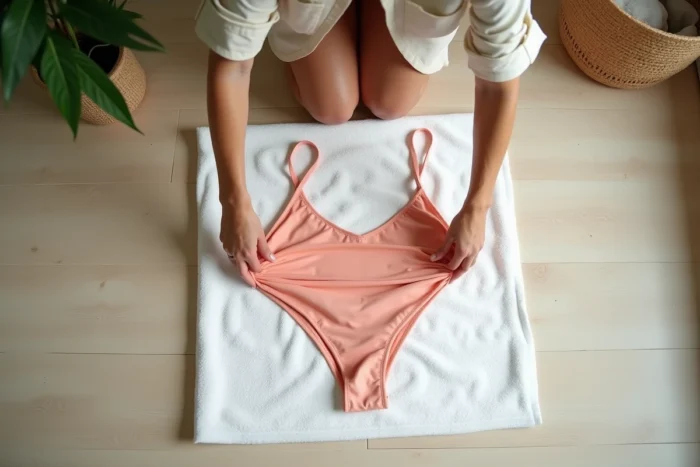
We recommend a gradual method that respects the structure of the knit. Soaking the swimsuit in lukewarm water (never hot) for about fifteen minutes, then putting it on while still damp and performing slow stretching movements allows the fabric to conform to the body without forcing the fibers.
Stretching is always done on wet fabric, as water acts as a lubricant between the knit threads and reduces the risk of mechanical breakage of the stitches. On dry fabric, the friction between fibers is too high: it distorts the knit instead of relaxing it evenly.
Localized stretching on compression areas
If discomfort is concentrated in a specific area (crotch, bust circumference, thigh elastic), we observe better results with targeted stretching. Simply place the damp swimsuit on a rounded object with a diameter slightly larger than the desired measurement, such as a sports ball, and let it dry flat in that position.
This technique works because the knit, drying under moderate tension, stabilizes its stitches in a more open configuration. The result is more durable compared to simply wearing it wet.
Methods to avoid: white vinegar and steam
Several tutorials recommend a white vinegar bath to “soften” synthetic fibers. Vinegar has no documented effect on elastane. Its acidic action is suitable for natural fibers (wool, cotton) by releasing hydrogen bonds, but segmented polyurethane does not react to this type of treatment.
Steam from an iron poses a similar problem. The steam temperature far exceeds the tolerance threshold of elastane, and the result is often the opposite: the swimsuit retracts further in the exposed areas.
- Hot water above 40 °C: causes retraction of the rigid segments of elastane, irreversible beyond a certain threshold.
- White vinegar: effective on cotton and wool, with no measurable effect on synthetic fibers like polyamide/elastane.
- Tumble dryer, even on low heat: the combination of heat and mechanical friction of the drum accelerates fabric degradation.
- Manual twisting to wring out: distorts the knit asymmetrically and creates weak spots in the stitches.

Release of microfibers and impact of repeated manipulations
A rarely addressed aspect in practical guides concerns the release of plastic microfibers. The French environmental display system for textiles now includes this indicator for synthetic clothing. Swimsuits made of polyamide/elastane are directly affected.
Repeated hot baths and forced stretching increase microfiber emissions during washing. Each aggressive manipulation weakens the surface of the knit, releasing microscopic polyamide fragments that end up in wastewater. Brands are beginning to incorporate this data into their care recommendations.
Favoring a gentle and unique method rather than repeated attempts reduces both the risk of deforming the swimsuit and its environmental impact. A swimsuit that is forced multiple times loses its shape and releases more particles.
Adjustment by sewing: the sustainable solution for a too tight swimsuit
When stretching is not enough, sewing alterations remain the most reliable option. We recommend entrusting the swimsuit to a workshop that works with stretch fabrics, as sewing elastane requires a ballpoint needle and a zigzag stitch or a cover stitch.
The most common alterations on a too tight swimsuit involve:
- Widening the side seams by loosening the internal seam allowances if the design allows.
- Replacing a too short thigh or back elastic with a softer lingerie elastic.
- Adding a mesh or lace insert in a tone-on-tone color on the sides, which adds volume without altering the design.
This approach has a cost, but it extends the lifespan of the swimsuit by several seasons, which offsets the initial investment. A swimsuit adjusted by sewing also retains its shape better than one stretched mechanically.
The composition of new swimsuits is evolving with European regulations on PFAS and hydrophobic surface treatments. Future collections may behave differently when stretched, as treatments that stiffen the fabric are gradually being replaced. Testing the stretching method on a less visible area remains the basic precaution before any manipulation on a recent swimsuit whose finish is unknown.