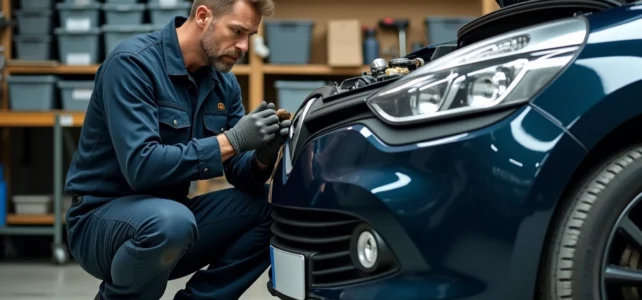
Finding the right spare part for a Renault relies less on knowledge of the model than on mastering a code: the OEM reference. This number, assigned by the manufacturer to each component, is the only reliable identifier to ensure a part’s compatibility with your vehicle. Searching by model name and year of first registration often leads to errors, as the same Clio or Mégane can exist in dozens of engine, trim, and equipment variants.
Renault OEM Reference: The Starting Point for Any Reliable Search
The OEM (Original Equipment Manufacturer) number refers to the unique manufacturer reference of a part. It encodes information about dimensions, material, and intended installation. Two visually identical oil filters may have different OEMs and may not fit the same engine block.
The most direct method to obtain this number is to use the VIN (Vehicle Identification Number), found in field E of the registration document. By entering this code into an electronic Renault parts catalog, you gain access to the exploded diagrams of the exact vehicle, along with the list of factory-installed references. This VIN-based approach significantly reduces ordering errors compared to searching by model or year alone.
For owners who wish to delve deeper into this process, a detailed guide explains how to utilize the manufacturer’s digital tools starting from the Renault reference on Moteur Mag, complete with screenshots of the catalogs and step-by-step instructions.
The identification plate, located on the passenger door side, also provides the vehicle type and trim. Photographing this plate with a smartphone before any order avoids the need to return to the vehicle in case of doubt.

Inter-Model Compatibility within the Renault Group: An Underutilized Lever
The Renault group shares many mechanical components among its brands and models. The 1.5 dCi K9K engine, for example, is used in the Clio, Mégane, Kangoo, Logan, and Sandero. A part referenced for one of these vehicles can therefore fit another, provided that the OEM number is strictly identical.
This inter-model compatibility opens up concrete possibilities for the owner:
- Access to a wider stock by searching for the same reference across multiple model sheets, improving availability and shortening lead times
- Comparing prices between listings associated with different vehicles in the group (Renault, Dacia, Nissan) for a rigorously identical part
- Finding a used part in good condition on a less sought-after model, thus cheaper in the salvage market
Field reports vary on this point: some independent garages systematically check cross-compatibility to offer alternatives to their clients, while others stick to the catalog of the exact model. Checking the OEM number remains the only reliable arbiter.
Cross-References and Choosing Between Original or Aftermarket Parts
Once the Renault OEM reference is identified, cross-reference databases allow you to find equivalents from several manufacturers: Denso, NRF, Metzger, Thermotec, among others. The principle is simple: each manufacturer assigns its own code to a part produced according to the same specifications.
This correspondence allows for a choice between three levels of range:
- The original part (bearing the Renault logo), manufactured by a supplier on behalf of the manufacturer, sold at the highest price
- The premium part from the supplier itself, technically identical but marketed under its own brand, often cheaper
- The standard or adaptable part, compliant with dimensions but sometimes made with different materials or tolerances
For certain families of parts for the recent engines of the Renault group (0.9, 1.0, 1.2, 1.3, 1.6), suppliers like Magneti Marelli plan to expand their aftermarket range in 2026, particularly on ignition coils. This type of expansion in the aftermarket catalog directly benefits owners of recent vehicles, who until now had limited choices outside the manufacturer’s network.
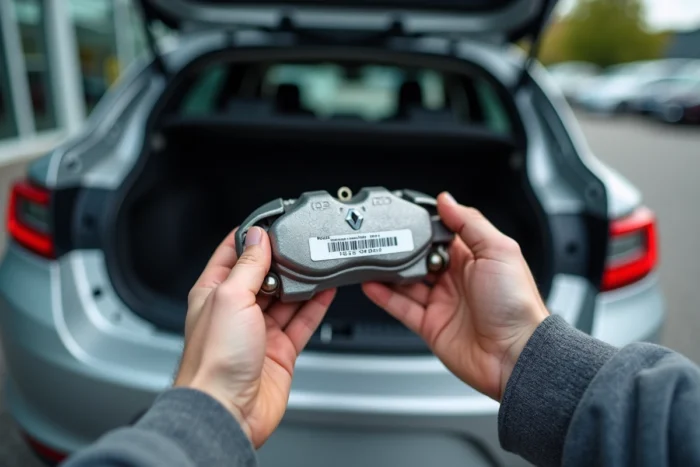
Check Before Ordering: Common Pitfalls
The most common pitfall concerns body parts. Two front bumpers for a Clio IV may differ depending on the phase (facelift), the presence or absence of parking sensors, or the type of headlights. The model and year are not enough: only the OEM reference guarantees the correct mounting geometry.
Another pitfall affects electronic parts or sensors. On vehicles produced after 2015, the part number sometimes includes a software version. Ordering a sensor with a similar but not identical OEM can lead to a communication failure with the ECU, without any visible signs upon installation.
Manual Validation and Customer Service of Online Platforms
Major online parts retailers have developed manual validation services: the buyer submits their VIN or registration document, and an operator confirms compatibility before shipping. This type of human verification complements the catalog search usefully, especially for complex or expensive parts.
Some platforms also integrate automatic alerts when an OEM corresponds to multiple vehicles, indicating cross-compatibility without the buyer needing to search for it. The reliability of these systems depends on the quality of the database used, and the available data does not always cover older models or special series.
The safest reflex remains to note the OEM reference before removing the used part, compare it with the one displayed in the catalog by VIN, and then verify the correspondence on a cross-reference database. Three checks, a few minutes, and the likelihood of ordering errors becomes negligible.