
The question of at what age one can go to Basic Fit frequently arises among parents and teenagers drawn to fitness. The answer lies in a simple threshold, 16 years minimum, but the conditions surrounding it deserve a closer examination: the legal nature of this limit, registration formalities for a minor, actual access restrictions, and recent seasonal alternatives.
Minimum age at Basic Fit: internal rule or legal obligation
In France, no law sets a unique minimum age for accessing a private gym. Each brand freely defines its own admission criteria in its internal regulations. The 16-year limit applied by Basic Fit is therefore part of a commercial and safety policy specific to the chain, not a national regulatory framework.
This distinction has a direct consequence: other fitness networks may set their threshold at 14 or 15 years, while some independent clubs accept even younger profiles under certain supervision conditions. To better understand at what age can one go to Basic Fit, it is necessary to distinguish this internal policy from the French legal framework.

Registration conditions for minors aged 16 and 17
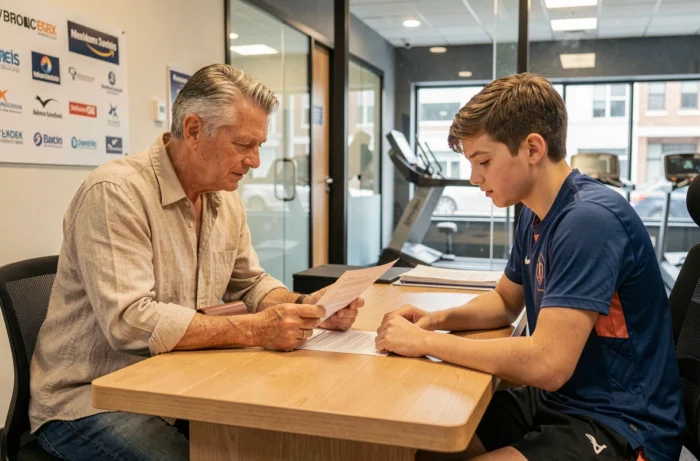
A teenager aged 16 or 17 cannot subscribe to a Basic Fit membership alone. French civil law prohibits unemancipated minors from signing a subscription contract that involves recurring payments.
In practice, the process requires the presence and signature of a parent or legal guardian. It is this representative who commits contractually. In the event of identity theft or false declaration regarding age, Basic Fit reserves the right to immediately terminate the contract.
Required documents and formalities
- A piece of identification for the minor proving they are at least 16 years old at the time of registration
- The signature of the parent or legal guardian on the subscription contract, along with their own identification
- A formal parental authorization, kept by the club as proof in case of internal checks
The absence of any of these elements blocks registration. No exceptions are granted, even for a young athlete supervised in a club or presenting an advanced level.
Comparative table: gym access by age and status
| Age group | Basic Fit access | Conditions |
|---|---|---|
| Under 16 years | Denied | No exceptions, even with parental consent |
| 16-17 years | Allowed | Mandatory signature of parent/guardian, identification |
| 18 years and older | Allowed | Independent registration, with no special conditions |
This table summarizes Basic Fit’s position. The 16-year rule is applied without leeway, regardless of the club or the country where the brand is located.
Seasonal Youth Pass: a supervised opening for 14-17 year olds
Basic Fit launched a free two-week “Youth Pass” in the summer of 2026, specifically targeting teenagers. This seasonal initiative allows young people who are not yet old enough or able to subscribe to a regular membership to discover the facilities.
Access conditions remain very regulated: this pass does not replace a membership, its duration is strictly limited, and parental authorization is still required for minor participants. This scheme does not change the general 16-year rule for a permanent membership.
What this pass changes (and does not change)
- It temporarily opens the doors to teenagers from 14 years old, outside the usual contractual framework
- It does not involve any recurring payments or long-term contract signing
- It remains a seasonal marketing operation, with no guarantee of renewal from year to year
- Access to equipment may be restricted to certain areas or time slots during the pass period
Legal risks related to a minor’s subscription
A minor is legally incapable of contracting in the sense of the Civil Code. The acts that a minor can perform alone are limited to “ordinary acts,” a notion whose scope remains vague.
A monthly subscription with automatic payment does not fall into this category. The contract signed by the parent is therefore the only valid commitment. If a dispute arises (disputed payments, difficult termination), it is the legal representative who bears the responsibility, not the teenager.
This configuration creates a blind spot for families: the parent who signs commits to the minimum duration of the contract, even if the teenager stops attending the gym after a few weeks. The commitment period and termination conditions deserve careful reading before any signature.
The 16-year threshold at Basic Fit, often perceived as an arbitrary barrier, reflects a trade-off between commercial accessibility and the management of legal risk related to minors. For families, the key takeaway remains this: it is the parent who contracts, who pays, and who assumes responsibility for the contract, regardless of the age of the teenager who walks through the gym door.