French size 42 is based on a theoretical waist measurement, bust measurement, and hip measurement that vary according to the reference used by each manufacturer. Understanding these discrepancies between industrial standards helps ensure a reliable purchase, especially online where the wrong size remains the primary cause of returns in fashion.
Industrial Tolerances and Gradation Differences for Size 42
Each brand applies its own gradation between two consecutive sizes. The standard interval in French ready-to-wear is 4 cm per size for bust and hip measurements, and 2 to 4 cm for waist measurements. Therefore, a size 42 is theoretically +4 cm from a 40 and -4 cm from a 44 at the bust.
In practice, this consistency does not exist. Some brands compress the gradation between sizes 38 and 42 to flatter the customer (the infamous vanity sizing), then stretch it beyond size 44. Others maintain a constant step but shift the entire scale downward. We regularly observe discrepancies of 2 to 3 cm in bust measurement between two brands for the same size 42 label.
The concept of industrial tolerance exacerbates the ambiguity. In mass production, a deviation of plus or minus 1 cm per measurement is common and considered acceptable. Cumulatively across three measurements (bust, waist, hips), this can represent a sufficient shift to go from a proper fit to a garment that is too tight or too loose.
When looking for the size 42 waist measurement, it is important to remember that the number printed on the label is just a starting point, not a dimensional guarantee.
Size 42 Waist: Measurement on the Body and Measurement on the Garment
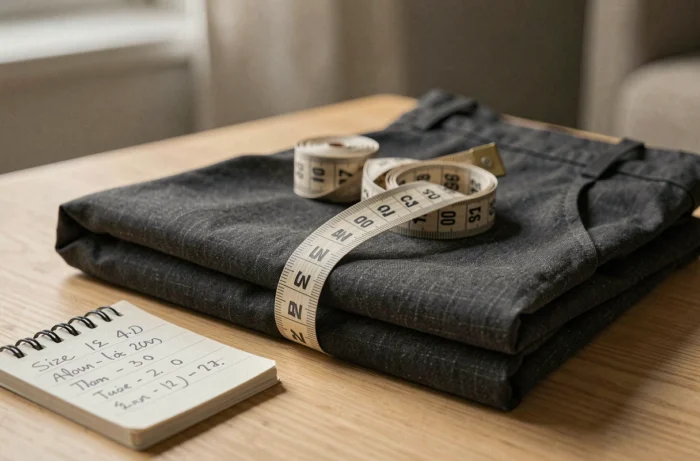
The most common confusion concerns the difference between body measurements and the dimensions of the finished garment. A size guide indicates your measurements (bust, waist, hips taken against the skin). The finished product chart, on the other hand, provides the dimensions of the garment laid flat.
A size 42 pant with a waist measurement of 37 cm (or 74 cm in circumference) when measured flat is not intended for someone with a 74 cm waist. Ease, meaning the extra fabric needed for comfort and movement, must be added.
For classic pants, an ease of 4 to 6 cm at the waist is recommended. For stretch jeans, it can go down to 0 cm, or even be negative due to the fabric’s elasticity.
Reliable Measurement Protocol
The waist is measured at the narrowest point of the torso, generally above the navel, without compressing the skin or puffing out the stomach. The measuring tape should remain horizontal and parallel to the ground.
- Measure standing, in underwear, with arms at your sides, at the end of a normal exhalation (not during forced apnea).
- Do not place a finger under the tape to “leave room”: ease is already accounted for by the pattern maker.
- Repeat the measurement twice and take the average, as posture can easily alter the result by a centimeter.
This protocol also applies to bust measurement (at the fullest point, tape passing under the armpits) and hip measurement (at the widest point of the pelvis).
International Size Correspondence for Women’s Size 42
The French system uses its own numbering. French size 42 corresponds to EU 42, UK 14, and US 10-12. In Italy, it generally translates to a 46. These equivalences remain approximate as each country relies on different measurement campaigns conducted at different times on different populations.
For jeans, the conversion goes through inches. A French size 42 waist measurement corresponds approximately to a W30 or W31 depending on the cut. Note that the W (waist) in American jeans refers to the waist measurement in inches measured on the garment, not on the body. A W30 has a circumference of 76 cm, which fits a slightly smaller body waist measurement.

Men’s Sizes and Common Confusion
In men’s sizing, the French system also assigns a 42 to a body type that is much narrower than that of women (a bust measurement of about 84 cm compared to a higher bust measurement for women’s size 42). A men’s 42 and a women’s 42 share no common measurements. Mixed or unisex guides that do not specify this distinction are systematically misleading.
Adapting Size Choice to the Type of Garment
The same body does not wear the same size across all garments. The choice depends on the construction of the pattern and the material used.
- A structured blazer with shoulder pads is chosen based on the bust measurement. If your hips exceed the size chart, go up a size and have the waist altered.
- A high-waisted pant is chosen based on the natural waist measurement, but a low-rise pant should be adjusted to the hip measurement.
- An fitted dress requires checking all three measurements (bust, waist, hips) and relying on the largest. It is better to alter excess fabric than to force a closure.
- For a knit or jersey garment, the elastane composition changes everything: beyond 5% elastane, the garment “forgives” easily a half-size.
Recent industry data confirms that the wrong size is the primary cause of returns in fashion e-commerce, ahead of product defects. Size 42, far from being marginal, accounts for nearly half of the female body types measured in France, along with sizes 40 and 44. Taking your measurements once a year and comparing them to the finished product guide of each brand remains the most reliable method to avoid a back-and-forth with the carrier.