A poorly sized hedge trimmer in relation to the plant produces crushed cuts, encourages fungal entry, and tires the operator well before reaching the end of the hedge. Choosing a suitable hedge trimmer requires considering three often underestimated technical parameters: tooth spacing, cutting kinematics, and the actual weight-balance ratio under operating conditions.
Tooth Spacing and Actual Cutting Diameter of the Hedge Trimmer
The tooth spacing determines the maximum branch diameter that the blade can shear cleanly. There is often confusion between the advertised spacing and the effective cutting capacity: a blade with a spacing of 30 mm does not necessarily cut 30 mm wood without straining.
On a cherry laurel or photinia, this year’s shoots remain thin, but neglected regrowth over two seasons produces semi-mature wood that requires wider spacing. Insufficient tooth spacing crushes the branch instead of shearing it, creating an irregular wound and slowing healing.
For a thuja or cypress that is regularly trimmed, a tighter spacing is suitable. However, for a country hedge mixing hornbeam, hazel, and hawthorn, we recommend a wide spacing coupled with a double-action blade. The difference is immediately felt in the quality of the finish and in the effort required to maintain the device against the plant.
Detailed technical references on blades and engines are available at taille-haie-warrior.com, with comparative sheets by type of plant.
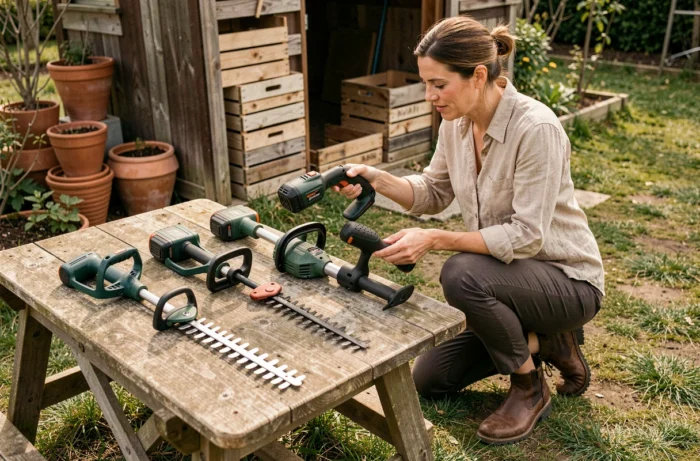
Battery, Corded, or Gas: Choosing Based on Hedge Length
The power source is determined by the length of hedge to be treated, not by the budget. A battery model is suitable for a few dozen meters of low hedge. Beyond that, voltage drop at the end of the charge degrades cutting quality on the last meters, precisely where the wood is often denser at the end of the property.
Battery: Voltage and Cell Chemistry
20 V platforms are sufficient for slow-growing decorative hedges (boxwood, yew). For palm laurel or vigorous privet, a 40 V platform maintains stable torque longer. The battery capacity in Ah determines autonomy, but it is the voltage that determines shearing power.
Gas: Reserved for Dense Hedges Over Long Lengths
A gas engine remains relevant beyond fifty meters of thick hedge, or when the branch diameter regularly exceeds what a battery model can handle without straining. The higher weight is offset by the lack of autonomy limits. We reserve it for country hedges, severe regrowth after several years without trimming, and landscaping projects.
Corded: The Underestimated Compromise
The corded electric hedge trimmer remains the lightest and most consistent in power. Its limit is strictly logistical: the extension cord. For a hedge running along the house on one side, it is often the most rational choice.
Weight, Balance, and Muscle Fatigue During Trimming
The weight displayed on the product sheet does not reflect the actual effort required. The balance of the device with the blade mounted matters more than the gross weight. A hedge trimmer of moderate mass but with a center of gravity too far forward towards the blade imposes a constant load on the wrists and shoulders, especially during vertical trimming on the sides of the hedge.
Two elements deserve verification before purchase:
- The position of the rear handle relative to the center of gravity: a rotating handle allows the device to be tilted without twisting the wrist during vertical passes
- The presence of a protective shield integrated into the blade, which adds weight at the tip but protects against debris and guides the cut vegetation
- The type of anti-vibration system, which reduces fatigue during long sessions and preserves the operator’s joints
When trimming high, above shoulder height, every additional hundred grams translates into lost minutes of work. For hedges exceeding two meters, a telescopic pole model avoids the need for a ladder, but the lever arm amplifies the sensation of weight.
Regulatory Constraints: Trimming Hours and Nesting Period
The Public Health Code (article R1336-5) regulates noise from motorized gardening tools. The authorized time slots vary by municipality, but the most common framework is summarized as follows:
- Monday to Friday: approximately 8:30 AM to 12 PM and 2 PM to 7:30 PM
- Saturday: approximately 9 AM to 12 PM and 3 PM to 7 PM
- Sundays and public holidays: often limited to 10 AM-12 PM, sometimes prohibited according to municipal decrees
Failure to comply with these time slots exposes one to a fixed fine of 68 euros, increased to 180 euros in case of late payment. We recommend checking the prefectural or municipal decree before any extended session, particularly with a gas model whose noise level is significantly higher.
Furthermore, the French Office for Biodiversity advises avoiding trimming from March 15 to July 31, during the bird nesting period. Trimming outside the nesting period protects wildlife and improves plant regrowth, as late summer or autumn cuts heal better on most hedge species.
Blade Maintenance: Resin, Sharpening, and Lubrication
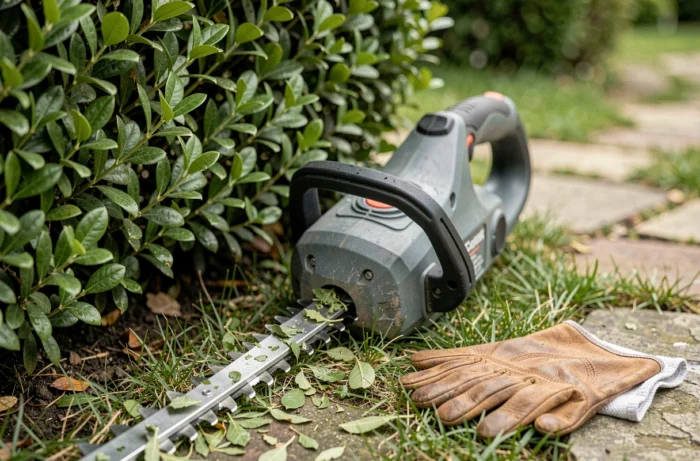
A blade clogged with plant resin loses cutting efficiency after just a few linear meters. On conifers (thuja, Leyland cypress), resin accumulates between the teeth and increases friction, which puts more strain on the motor and heats the blade.
After each use, cleaning with denatured alcohol or an appropriate solvent is sufficient to dissolve deposits. A light coating of lubricant on the blades after cleaning reduces oxidation and facilitates sliding during the next session.
Sharpening is done with a fine flat file, following the original angle of each tooth. Irregular sharpening disrupts the cut and creates unwanted vibrations. For professional models, we recommend checking the condition of the teeth approximately every ten hours of use.
Choosing a hedge trimmer is not just about comparing technical sheets. It is the intersection of the type of plant, the actual length, and the working posture that determines the suitable tool. A well-chosen and properly maintained model remains operational for many seasons without loss of cutting quality.