
When preparing a tender for diplomas, certificates of authenticity, or administrative titles, the first concrete question is that of the substrate. A poorly adapted watermark for the paper, or paper that does not withstand attempts at reproduction, renders the entire security system useless. The choice of a secure watermark paper is based on precise technical criteria, not just a simple mention of “secure paper” in a supplier catalog.
Cellulose or composite substrate: the choice that conditions everything else
We often think in terms of watermark without questioning the substrate itself. This is a mistake. The type of base (100% cotton paper, cellulose-synthetic blend, polymer-paper composite substrate) determines compatibility with printing processes, the mechanical strength of the document, and the durability of the watermark over time.
Composite substrates, which combine a polymer layer and a cellulose layer, are increasingly used for passports, banknotes, and identity documents. They allow for the integration of transparent windows and holographic elements directly into the thickness of the substrate. A secure watermark paper for official documents is no longer limited to a pattern visible by transparency: it must be able to accommodate multiple security layers without compromising printability.
For documents with a limited lifespan (exam vouchers, temporary certificates), 100% cellulose paper with a molded watermark remains a solid and economical choice. For long-term titles, we lean towards substrates that are more resistant to moisture and repeated handling.
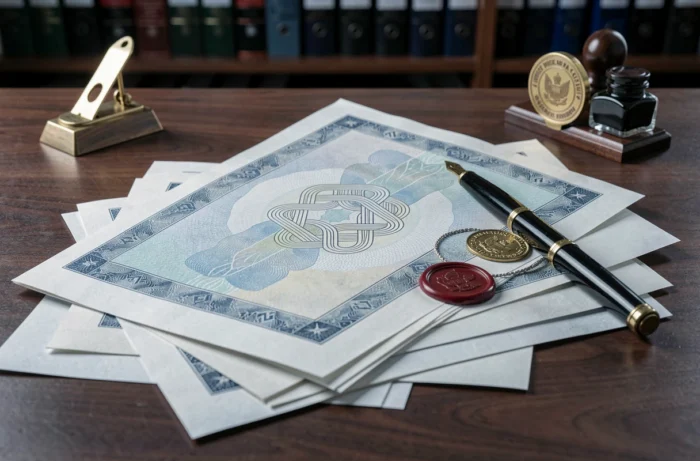
Clear watermark, shaded watermark, multi-tone watermark: technical selection criteria
The term “watermark” encompasses very different realities in terms of manufacturing and level of protection.
- The clear watermark (or line watermark) allows more light to pass through certain areas of the paper. It is the simplest to produce, but also the easiest to imitate by inkjet printing on thin paper.
- The shaded watermark creates variations in thickness in the pulp, producing a gradient visible by transparency. Its reproduction by a counterfeiter requires industrial equipment, making it significantly more deterrent.
- The multi-tone watermark combines light and shaded areas to form a portrait or complex pattern. It is the standard for banknotes and passports. Its manufacturing cost is higher, but it remains the most difficult watermark to counterfeit.
For an official company or administration document, the shaded watermark offers the best balance between production cost and resistance to counterfeiting. The multi-tone is justified when the volume of documents is sufficient to amortize the investment in the manufacturing cylinder.
Check compatibility with your printing equipment
A high grammage watermark paper does not pass through all copiers or offset presses. Before ordering a batch, it is essential to request a sample to test the paper’s behavior in the actual printing chain. Feedback on this point varies among suppliers: some composite substrates pose problems of jamming or ink adhesion on older machines.
Complementary securities integrated into watermark paper
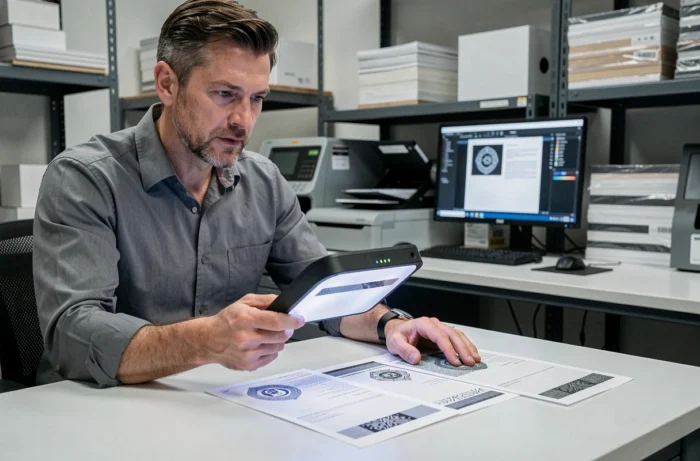
A watermark alone is no longer sufficient to protect a document against current reproduction techniques. High-resolution printers and color scanners make visual copying increasingly convincing. The current trend is to combine the watermark with machine-readable elements to allow for automated verification.
Among the complementary securities integrated directly into the paper:
- UV fibers, visible only under ultraviolet light, which confirm the authenticity of the substrate without requiring expensive equipment.
- Microtext printed within the mass of the paper, unreadable to the naked eye but detectable with a magnifying glass or scanner.
- Data-carrying security threads, partially embedded in the thickness, which can contain a unique serialized code per document.
- Thermochromic inks that change color with heat, adding a layer of tactile verification.
A paper that combines shaded watermark, UV fibers, and security thread covers the three levels of control: visual (transparency), instrumental (UV lamp), and automated (thread reader). This is the standard towards which official document renewal programs are heading.
Specifications: points to lock in before ordering
When ordering from a specialized paper manufacturer, ambiguity in the specifications is the primary source of problems. You end up with paper that does not meet the expected security level or is not compatible with the existing printing system.
Grammage and opacity
A grammage that is too low makes the watermark too visible in direct reading, which hinders the readability of the printed content. A grammage that is too high complicates folding and packaging. The right grammage depends on the final use of the document: a framed certificate tolerates thick paper, while a tri-fold form requires more flexibility.
Traceability and numbering
For high-value documents (diplomas, property titles, investment certificates), a sequential numbering integrated into the paper is requested from the manufacturing stage. Each sheet bears a unique identifier, allowing for tracing in the event of fraud. This option increases the unit cost but significantly simplifies stock management and detection of copies.
Minimum order volume
The production of custom watermark paper involves creating a mold (dandy roll or cylinder). This fixed cost is spread over the ordered volume. For runs of fewer than a few thousand sheets, it is better to opt for standard watermark papers available in catalogs, to which printing securities (guilloches, microtext, added holograms) are added.
The choice of watermark paper to protect official documents is not an isolated decision. It is part of a comprehensive system where the substrate, watermark, complementary securities, and printing chain must work together. Starting by defining the actual threat level to which the document will be exposed helps avoid both over-investment and false security.