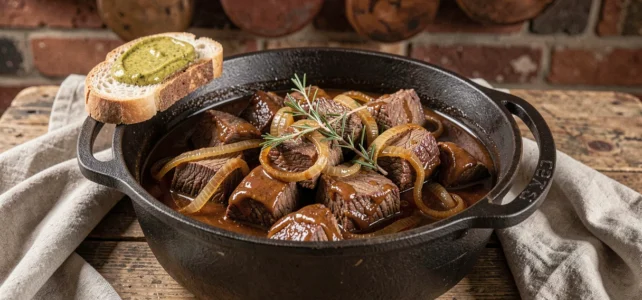
The Flemish carbonade and beef bourguignon share an identical technical foundation: braised beef, an acidic liquid, and long cooking in a pot. The difference lies in the nature of the cooking liquid and the resulting chemistry, and it is precisely this parameter that guides the choice for a dinner intended to make an impression.
Maillard Reaction and Beer Reduction: The Aromatic Engine of Flemish Carbonade
The bourguignon derives its depth from a tannic base: red wine deglazes the juices and then reduces, bringing acidity and structure. The carbonade relies on a distinct mechanism. Dark beer, rich in residual sugars and compounds from roasted malt, generates a slow reduction that concentrates notes of caramel and gentle bitterness. This reaction, combined with the Maillard effect obtained on the seared pieces of meat, produces a sweet-salty profile that the bourguignon does not achieve.
We recommend treating this difference as a true service lever. The umami profile of the carbonade surprises a French palate accustomed to wine-based sauces. For anyone interested in Belgian bourguignon in the kitchen, comparing the two sauce bases reveals two distinct braising philosophies.
The vinegar, present in traditional versions of the carbonade, further accentuates the gap. It adds a hint of volatile acidity that contrasts with the malty roundness, whereas the bourguignon remains on a more linear tannin-tartaric acidity axis.
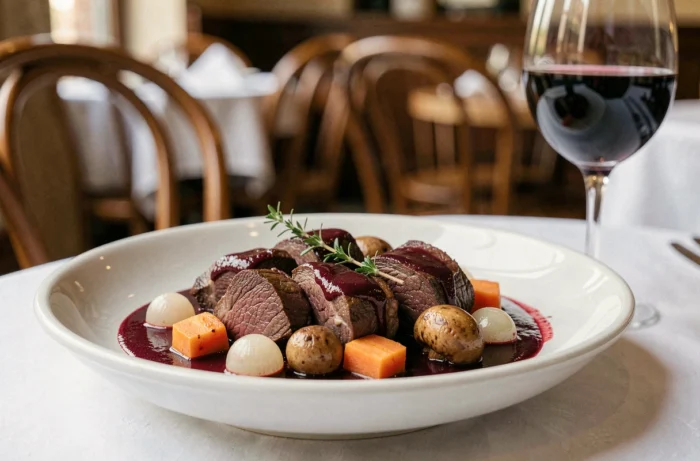
Flemish Carbonade: A Presentation That Disrupts Bourgeois Dinner Codes
Beef bourguignon arrives in a pot, often with steamed potatoes or a mash. The service is classic, clear, and reassuring. The carbonade opens up a completely different register.
In the tradition of Flemish estaminets, the carbonade is served with fries, not with bread or turned vegetables. This choice of garnish radically changes the table dynamic. The dish shifts from a “grand bourgeois dish” to that of a convivial brasserie meal, where diners pick, share, and comment.
For an impactful dinner, this shift works better than one might think. A technically mastered dish, served in an unexpected format, generates more conversation than a perfectly executed bourguignon, the service of which surprises no one. We observe that the carbonade consistently provokes reactions at the table, precisely because it does not match the mental image of a “chic stew”.
Gingerbread or Brown Sugar: A Decision Made During Cooking
The question arises in all forums: should the sauce be sweetened with brown sugar or gingerbread? Both add sweetness, but gingerbread brings a bouquet of spices (cinnamon, anise, clove) that complicates the sauce without requiring a separate addition. Brown sugar provides a clearer, more direct caramel.
Gingerbread pairs well with very malty dark beers, where the spices find an echo. Brown sugar works better with an amber beer, which is less loaded with roasted aromas. In both cases, the quantity remains modest: the sweetness should support, not dominate.
Beef Bourguignon: Which Wine and Which Meat for a Promising Result
The bourguignon requires a wine one would gladly drink at the table. A medium-quality Burgundy works better than a generic table wine because the flaws of the wine concentrate during reduction. The sauce of the bourguignon is a mirror of the wine used: astringent tannins, unbalanced acidity, or flat fruitiness are amplified after two hours in the pot.
For the meat, the preferred cuts are those rich in collagen:
- Chuck, which falls apart into melting strands after a long braise, remains the most reliable choice for a consistent result
- Beef cheek offers a gelatinous texture and superior mouthfeel but requires a longer cooking time
- Brisket, leaner, is suitable if the sauce is sufficiently reduced to compensate for the lack of intramuscular fat
For the carbonade, the same cuts work. The difference lies in the thickness of the cut: the carbonade is traditionally prepared in thicker slices than the cubes of bourguignon, which alters the penetration of the liquid and the crust/core ratio.
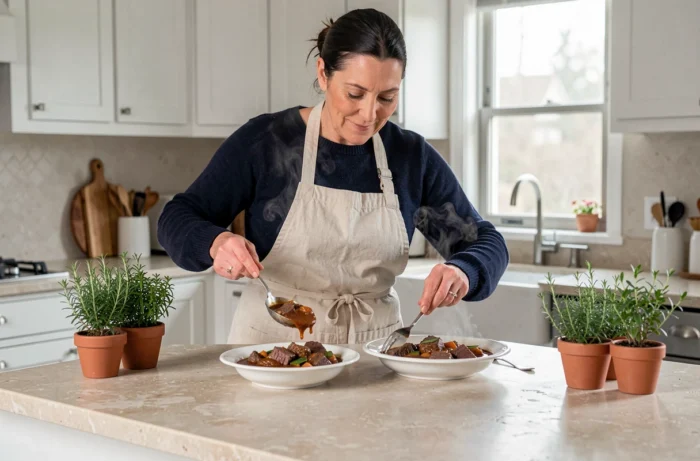
Beverage Pairing: Wine vs. Beer, A Choice That Structures the Entire Meal
Serving a bourguignon requires a red wine at the table. The dish dictates the drink, and by extension, the entire sequence of the meal. The carbonade frees one from this constraint.
The carbonade allows for a beer pairing that changes the atmosphere of the dinner. An abbey brown or a Scotch ale as accompaniment extends the flavor coherence of the dish. But there is nothing stopping one from serving a fruity and fresh red, a light Côtes-du-Rhône or a lightly oaked Pinot Noir, which pair well with the sweet-salty of the sauce.
The bourguignon, on the other hand, does not tolerate beer at the table well. Its tannic profile calls for a wine of the same register. This rigidity is not a flaw; it is a framework. For a dinner where wine is central (tasting, themed meal), the bourguignon remains the logical choice.
What the Choice of Dish Says About Your Dinner
The bourguignon reassures. It signals mastery of the classics, an anchoring in the French repertoire. The carbonade surprises, in a good way: it shows culinary curiosity and opens up a space for discussion that the bourguignon, too familiar, no longer creates.
For an informed audience, the Flemish carbonade creates more conversation at the table than the bourguignon. For a formal dinner where the setting takes precedence over surprise, the bourguignon remains a safe choice. The real criterion is not the technical difficulty (both dishes require the same level of mastery) but the desired effect: validated prestige or shared curiosity.