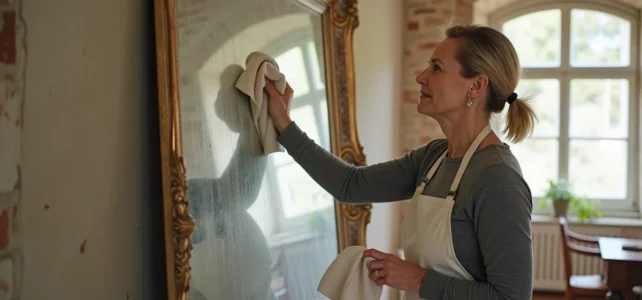
An antique mirror hanging above a fireplace, with its scattered dark spots on the backing, poses a very concrete question: do we clean it, restore it, or move on? The answer depends less on the charm of the object than on the actual extent of the damage to the reflective layer. Restoring a spotted mirror is often feasible, but certain alterations make the operation counterproductive.
Restoration threshold of a spotted mirror: when to stop the expenses
One always starts by laying the mirror flat, reflective side up, under raking light. The spots then appear as black or grayish dots, sometimes surrounded by a lighter halo. It is the condition of the backing, this thin layer of silver or aluminum deposited behind the glass, that determines the course of action.
If the black spots are concentrated only on the edges of the mirror, on a band of a few centimeters, we are in a favorable case. Humidity has attacked the periphery of the backing without compromising the central surface. A gentle cleaning and a few touch-ups are often sufficient.
On the other hand, when the spots cover more than half of the surface, artisanal restoration loses its meaning. The remaining backing is too fragile to withstand cleaning without further degrading. We enter the zone where only professional re-backing (complete replacement of the reflective layer) or replacing the mirror glass in the original frame yields a lasting result. Knowing how to recognize this threshold saves you hours of work for a disappointing outcome.
To delve deeper into the techniques suited to each level of wear, you can also see how to restore a damaged spotted mirror according to the type of backing involved.
Cleaning damaged backing: gentle method and common mistakes
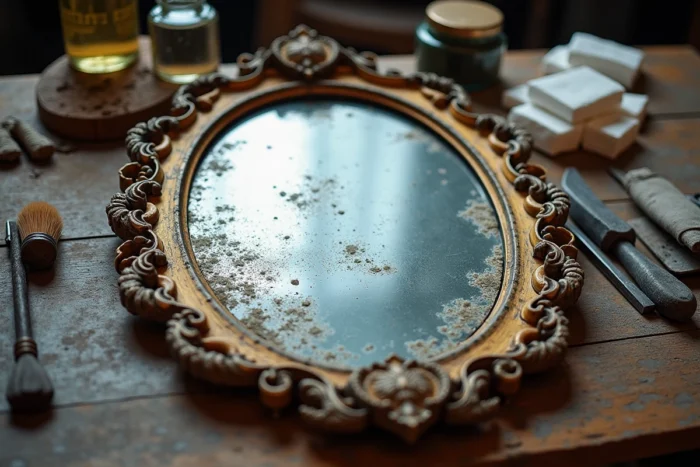
For a mirror with localized spots, cleaning is the first step. Work on the glass side (the front face), never directly on the backing at the back. The basic rule: no product should run over the edges or stagnate at the glass-frame junction.
What works without risk
- Diluted Meudon white in a bit of warm water, applied with a microfiber cloth, cleans the glass without attacking the backing by capillarity. Wipe immediately, without letting it dry.
- Very diluted white vinegar (one tablespoon in half a liter of water) removes limescale marks on the front face. Spray on the cloth, not on the mirror.
- A simple dry wipe with a clean cloth after each exposure to steam (bathroom, kitchen) slows the progression of spots on still healthy mirrors.
What worsens the damage
Products containing ammonia, abrasive sponges, and pure alcohol attack what remains of the backing. Mirrors are often seen where the spots have spread after overly aggressive cleaning. Stagnant water on the edges remains the most common corrosion factor, even on recent mirrors.
Opinions vary on the effectiveness of toothpaste or baking soda, sometimes recommended online. On an old backing that is very weakened, their fine grain can be enough to scratch the surface. It is better to stick to Meudon white, which is less risky.
Local touch-ups on a spotted mirror: concrete techniques
When the spots are few but visible, one can intervene in two ways without touching the remaining backing.
The adhesive aluminum foil stuck to the back of the mirror, behind each spotted area, recreates a partial reflective effect. Cut the foil to the size of the spot, smooth it carefully to avoid bubbles, and secure it with a transparent adhesive resistant to moisture. The result does not equal a new backing, but the dark spots visually disappear from the front face.
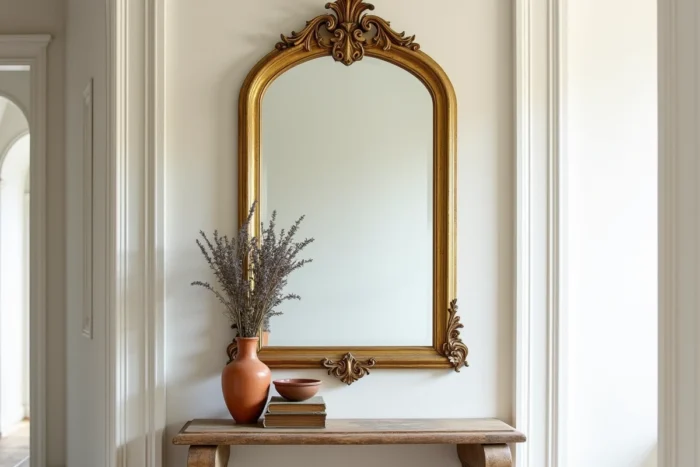
The other option is to embrace the patinated style of the spotted mirror and treat it as a deliberately decorative element. In this case, simply stabilize the existing backing by applying a layer of protective varnish to the back, to prevent moisture from continuing its work. This approach works well on mirrors with old frames, where the aged appearance contributes to the character of the room.
Professional re-backing or replacement of mirror glass
A family mirror with an ornate frame sometimes deserves an investment in complete re-backing. The operation consists of removing the old backing by chemical stripping, then depositing a new layer of silver on the original glass. This work is the domain of a professional glazier.
Re-backing preserves the old glass (often thicker and more irregular than contemporary glass, which gives it character). However, if the glass itself has cracks or chips, replacing it with new mirror glass cut to the dimensions of the frame remains the most reliable solution.
- Re-backing: suitable when the glass is intact and the frame has heritage or sentimental value.
- Replacement of mirror glass: preferable if the glass is cracked, if the spots are too extensive, or if the mirror is in a humid room (bathroom).
- Conservation as is with protective varnish: relevant for a decorative mirror where the patinated appearance adds charm.
A bathroom mirror spotted over more than a third of its surface costs less to replace than to restore. The budget question often cuts the debate, especially on mirrors without a particular frame.
For mirrors that are kept, preventive maintenance makes a difference in the long term. Wiping condensation quickly, avoiding frames placed directly against a damp wall, and periodically checking the condition of the edges of the backing are enough to slow the progression of spots for years.