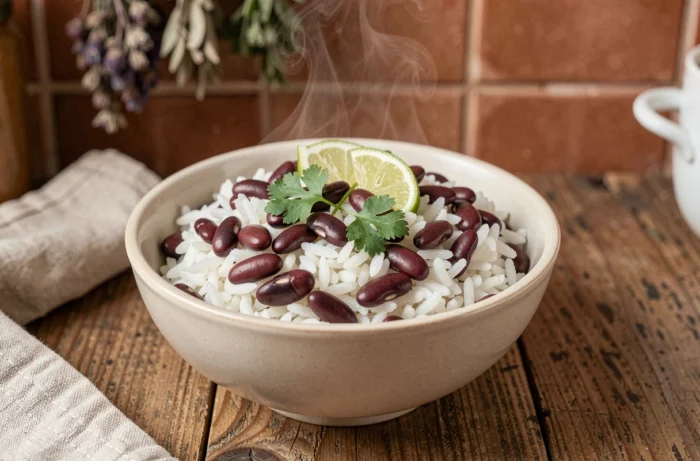
The duo of rice and red beans has been nourishing entire populations for centuries, from Brazil to the Caribbean and across West Africa. This cheap and filling dish often appears on plates when looking to eat well without breaking the bank. One legitimate question remains: can it be made a daily meal without disrupting one’s diet?
Complete proteins from rice and red beans: why this duo works
Red beans provide lysine, an amino acid that rice contains in small amounts. Conversely, rice provides methionine, which is low in legumes. Together, they form what is known as a complete protein through complementation.
In practical terms, this means that your body has all the necessary amino acids for muscle building and cell renewal, without meat or fish on the plate. This is, in fact, the principle that millions of people apply daily in Latin American and Caribbean kitchens.
You can explore the benefits of red beans with 10 Grammes to understand their nutritional profile in detail.
Beyond proteins, red beans are rich in dietary fiber, iron, potassium, and folate. Rice, on the other hand, provides energy in the form of complex carbohydrates. The combination covers a large portion of basic nutritional needs.
Arsenic in rice: the real risk of daily consumption
Few public nutritional guides address this point, and it is an angle that competitors overlook. Rice naturally absorbs inorganic arsenic present in soils and irrigation water. In occasional doses, this is not a problem. In daily doses, the issue deserves attention.
The European Union has tightened and consolidated the limits of inorganic arsenic in rice with regulation (EU) 2023/915, which came into effect in May 2023. This text sets specific thresholds according to rice categories (white, husked, infant products, rice snacks). Additional adjustments were made in 2026 through regulations (EU) 2026/1825 and 2026/1890.
Brown rice contains more arsenic than white rice, as arsenic concentrates in the grain’s husk. If you eat rice every day, opting for well-rinsed white rice reduces exposure.
Reducing arsenic through preparation
- Rinsing rice thoroughly before cooking, changing the water several times, significantly decreases arsenic content
- Cooking rice in a large volume of water (like pasta) and then draining removes additional contaminants
- Alternating grain sources (quinoa, bulgur, millet) a few days a week limits accumulation
This is not a reason to ban rice, but a reason to vary and pay attention to preparation when consuming it daily.
Fiber and digestion: what the stomach says after a few weeks
Have you ever noticed bloating after a dish of red beans? It’s normal. Legumes contain oligosaccharides, sugars that our small intestine cannot digest. They arrive intact in the colon, where bacteria ferment them, producing gas.
The good news is that the microbiota adapts within a few weeks of regular consumption. Bloating decreases as gut flora rebalances. This is a well-documented phenomenon for all legumes.
Soaking dried beans for an extended period (at least eight hours) followed by thorough cooking reduces the amount of oligosaccharides. Discarding the soaking water before cooking is a step not to be overlooked. Canned beans, already cooked, pose less of this problem as some of the fermentable sugars leach into the preserving liquid.
Lectins and phytohemagglutinin: cook sufficiently
Raw red beans contain phytohemagglutinin, a toxic lectin that causes nausea, vomiting, and diarrhea. Boiling for at least ten minutes destroys this toxin. Dried beans that are simply soaked or cooked at low temperatures (in a slow cooker without prior boiling) can remain dangerous.
Canned beans do not pose this risk: they have undergone sufficient industrial heat treatment.
Nutritional limits of rice and beans daily
As complete as this duo may seem, it has deficiencies if strictly limited. Here’s what is missing from a plate composed solely of rice and red beans:
- Vitamin B12, absent from plant foods, requires intake through animal products or supplementation
- Vitamin C, nearly non-existent in cooked rice and beans, is necessary to enhance the absorption of non-heme iron they contain
- Omega-3 fatty acids, absent from this duo, play a role in cardiovascular and brain health
- Calcium remains low in both foods, which can pose a problem in the long term without dairy products or green vegetables
Adding fresh vegetables changes the game. Spinach, broccoli, or bell peppers provide the vitamin C that enhances iron absorption from beans. A drizzle of canola oil or a handful of nuts rounds out the lipid profile.
Rice and red beans form a solid base, not a complete diet. This is the nuance that separates a healthy food foundation from a monotonous diet at risk.
Blood sugar and satiety: an asset for daily meals
Red beans have a low glycemic index. When paired with white rice (which has a higher glycemic index), they slow carbohydrate absorption and smooth out the blood sugar curve after meals. The soluble fibers from the beans form a gel in the stomach that prolongs the feeling of fullness.
For those monitoring their blood sugar, replacing part of the white rice with brown or basmati rice further improves the glycemic response. Basmati rice, due to its unique starch structure, releases its glucose more slowly than other varieties of white rice.
This duo remains one of the most economical meals for achieving stable caloric intake, plant-based proteins, and ample fiber. Populations that traditionally consume it do so for a reason: the balance between cost, satiety, and nutritional value is hard to beat with other equally simple combinations.
Eating rice and red beans every day does not pose a major problem as long as the rice is rinsed and cooked properly, the dried beans are well prepared, and especially when this base is accompanied by a variety of vegetables, a source of vitamin C, and quality fats. Dietary monotony, not the duo itself, represents the real trap.