Sublimating an interior doesn’t necessarily require a large budget or a catalog of fleeting trends. What often distinguishes a successful decoration lies in a few precise gestures, well-chosen materials, and a logic of reuse that is gaining ground, even if the sector remains marginal. Here are ten concrete ideas to transform your space without replacing everything.
1. Lime patina on an accent wall
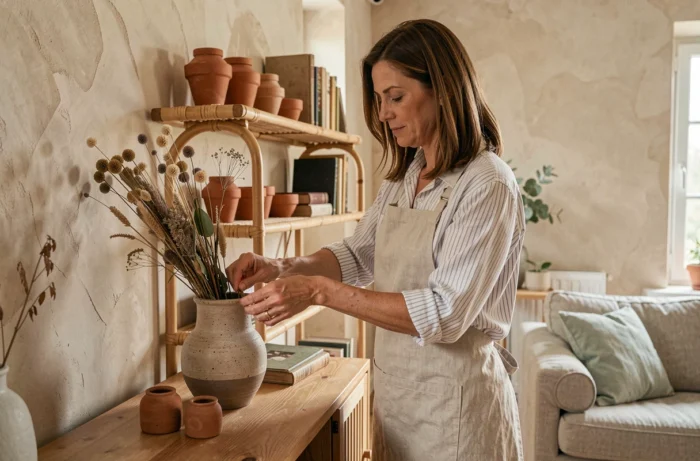
Lime applied in thin layers on a single wall creates a visual depth that standard acrylic paint does not replicate. The matte and slightly irregular finish adds a handcrafted character to the room.
An accent wall in lime works particularly well behind a headboard or as a backdrop in a living room. The cost of the material remains modest, and the technique does not require specialized tools. To go further, check out Cécile Bricole’s decorating tips that detail this type of project.
2. Repurposing wooden crates for wall storage
Raw wooden crates, fixed to the wall horizontally, form low-profile shelves. They are suitable for narrow entryways, children’s rooms, or bathrooms.
The untreated wood can receive a clear stain or remain raw for a bold natural spirit in the room. The entire setup can be assembled in under an hour with a few screws and plugs suitable for the support.
3. Upcycling vintage textiles for custom cushions
Embroidered tablecloths, linen dish towels, outdated curtains: these forgotten fabrics in closets can be transformed into unique cushion covers. A basic sewing machine is enough to assemble two sides and a closure.
Recycling an old fabric avoids the purchase of new textiles while introducing a texture that industrial cushions do not offer. The contrast between a contemporary sofa and vintage linen cushions creates a visual shift that adds character to the whole.
4. Creating a mismatched frame wall
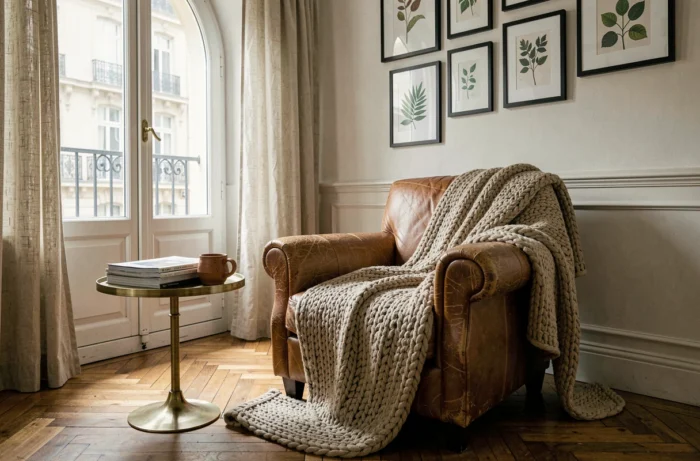
Hanging frames of different sizes, materials, and eras on the same wall creates a gallery effect. The rule that works: maintain a consistent distance between each frame, regardless of its size.
The contents can vary freely (prints, photos, pressed herbariums, book pages). What unifies the whole is the regularity of the spacing, not the homogeneity of the objects.
5. Inserting vintage furniture into a contemporary decor
A 1950s sideboard, a Thonet chair, or a small walnut desk introduces a visual density absent from current furniture. Combining an antique piece with a sober interior avoids the showroom effect.
The market for antique furniture remains accessible, provided you check the structural condition of the piece before purchase. Re-glued legs, sticking drawers, peeling veneer: these defects can be repaired, but they affect the price and the time required for intervention.
6. Indirect lighting with low-voltage garlands
Warm white LED garlands, placed behind a shelf, along a baseboard, or around a mirror, radically change the atmosphere of a bedroom or living room in the evening.
The electrical consumption of these devices remains negligible. Their main advantage: they eliminate harsh shadow areas created by a single ceiling light, visually enlarging the space.
7. Coffee table made from sanded and varnished pallets
The European pallet, once disassembled and reassembled, yields a standard-sized coffee table. Fine sanding followed by a matte varnish protects the wood and makes maintenance easier.
Adding industrial wheels under the structure makes the piece mobile. This type of project illustrates the logic of reuse well, even if, on a national scale, only a marginal fraction of objects and materials is actually reused. In 2025, Ecomaison indicated that reuse accounted for only about 5% of the 1.97 million tons processed.
8. Two-tone painting with a mid-height demarcation line
Painting the lower part of a wall in a bold shade and the upper part in white (or vice versa) visually structures the room without adding furniture. The demarcation line is generally placed between 1 m and 1.20 m from the floor.
This technique works well in hallways, entryways, and children’s rooms. It requires a quality masking tape and two pots of paint. The result transforms a mundane room into a graphic space.
9. Framed herbarium under glass
Pressing leaves or flowers between two glass plates held by clips creates a decorative botanical object. A few criteria for a durable result:
- Choose low-moisture plants (ferns, eucalyptus, grasses) for quick drying and long preservation
- Press between absorbent paper for at least two weeks before framing
- Place the frame out of direct light to avoid fading of natural pigments
This type of wall decoration fits well in both a living room and a bathroom, provided you avoid direct moisture on the glass.
10. XXL mirror placed on the floor to enlarge the space
A large mirror placed on the floor against a wall doubles the perception of depth in a narrow room. The effect is immediate, without any construction work or wall mounting.
Reclaimed mirrors (old fireplace mirrors, wardrobe doors) bring a patinated frame that enriches the decor. Caution: secure the base with non-slip wedges, especially in a home with children.
These ten ideas share a common thread: valuing what already exists rather than multiplying new purchases. Interior decoration gains character when it tells a story of materials and gestures, not a catalog. The PEMD diagnosis, mandatory for significant renovations exceeding 1,000 m² under the AGEC law, also reminds us that the traceability of materials is becoming a regulatory issue, even for individuals who recover construction elements.